:::
Regional Mobilization and Civilian Coordination Training Begins
2026/08/18
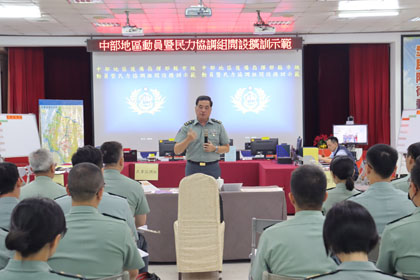
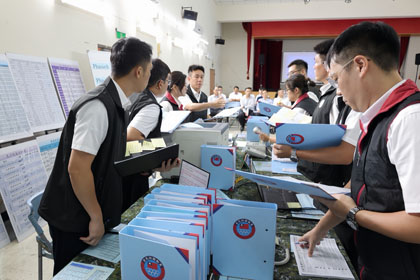
To enhance mobilization readiness and civil-military integration, reserve commands across Taiwan recently held a "Mobilization and Civil-Military Coordination Group Advanced Training Demonstration." The exercise was presided over by Commander Lieutenant General Yu, Deputy Commander Major General Ma, and Northern Region Reserve Command Commander Major General Li, bringing together commanding officers, chiefs of staff, section chiefs, and relevant personnel from regional county and city reserve commands. Through lectures, hands-on drills, scenario-response exercises, and joint discussion sessions, participants familiarized themselves with center activation procedures, duty-post responsibilities, system operations, and inter-agency coordination while validating operational processes. The exercise aimed to enhance the overall effectiveness of the Mobilization and Civil-Military Coordination Group through practical training and shared experience, thereby strengthening the military's peacetime-to-wartime transition capability.
Commander Yu emphasized that mobilization readiness is a vital foundation for reserve organizations as they advance three core missions: military mobilization, civil-military integration, and civil affairs coordination. He noted that reserve commands in every county and city must continuously refine their organizational structures and operating procedures based on local characteristics, mission requirements, and available resources to create operational models tailored to local needs. He further stated that, in addition to mastering the organizational structure, post responsibilities, and scenario-response procedures of the Mobilization and Civil-Military Coordination Group, personnel at all levels must use hands-on exercises to establish consistent standards and a shared operational vocabulary. Through experience sharing, process validation, and scenario-based drills, units can standardize execution procedures to ensure solid peacetime readiness and rapid wartime activation, maximizing the effectiveness of civil-military integration and civil affairs coordination.
Deputy Commander Ma emphasized that the Mobilization and Civil-Military Coordination Group plays a vital role in integrating local resources and supporting armed forces operations. He stressed that only by consistently implementing peacetime education, training, and validation — while thoroughly mastering operational procedures and inter-agency coordination mechanisms — can units achieve rapid resource integration and coordinated deployment during wartime. He further noted that exercises should serve as an opportunity to review existing plans and regulations, allowing units to refine outdated provisions to keep pace with evolving needs. Finally, Deputy Commander Ma encouraged all personnel to continue strengthening their professional competencies and deepening civil-military integration to build all-out defense mobilization capacity and whole-of-society defense resilience, laying a solid foundation for safeguarding the homeland.